Post Author:
Rev. Dr. Harold Marrero
Categories:
Date Posted:
September 2, 2026
Share This:
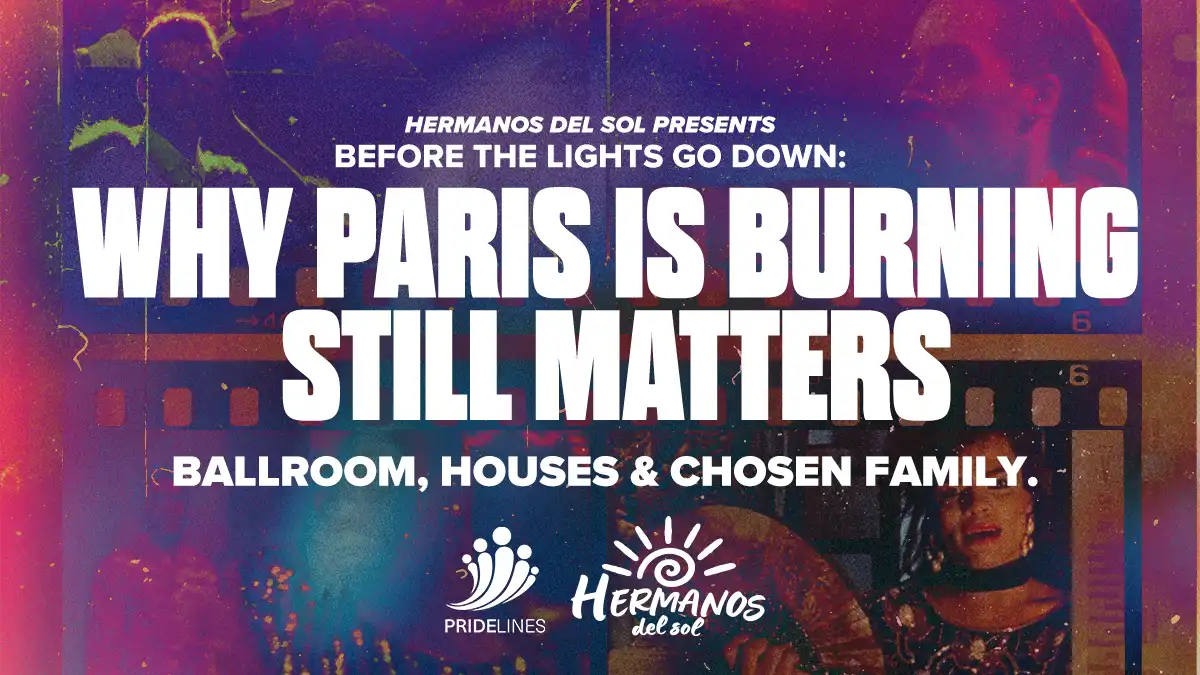
Before the Lights Go Down: Why Paris Is Burning Still Matters
On Tuesday, September 8, Hermanos del Sol hosts a screening and discussion of Paris Is Burning at Pridelines. Here is the history worth carrying into the room.
Somewhere in Harlem in the late 1980s, a young Black or Latino kid who has been told all week that he is too much, too feminine, too poor, too dark, or simply too visible steps onto a floor in front of a crowd that has decided, for one night, that he is exactly enough. He walks a category. The crowd calls for tens. If he wins, he carries a trophy back to a table where people who share his last name, a name none of them were born with, are waiting to celebrate him. Paris Is Burning filmed that world at a moment when almost no one outside it was paying attention, and it has been arguing with its audience ever since. Before we gather to watch it together, it helps to know where ballroom came from, what the film gets right, what it leaves unresolved, and why a Latino men’s group in Miami Beach is the right host for this conversation.
Where ballroom came from
Drag balls in Harlem go back at least a century. The Hamilton Lodge balls of the 1920s and 1930s drew thousands of spectators, Black and white, to watch contestants in gowns compete for prizes, and newspapers of the era covered them the way they covered any society event. By the 1960s the pageant circuit had become integrated in name and segregated in practice: Black queens competed but rarely won, and the judging favored a white standard of beauty. The 1968 documentary The Queen caught Crystal LaBeija losing a national pageant and telling the room, on camera, exactly why. A few years later she founded the House of LaBeija, and the modern house system was born. Houses took the names of their founders or borrowed the names of fashion houses, and each one gathered a family around a mother, sometimes a father, who fed people, housed them, taught them to walk, and stood up for them when nobody else would. In 1982 Hector Xtravaganza founded the House of Xtravaganza, the first house built primarily by and for Latino members, and its mother, Angie Xtravaganza, is one of the anchoring presences of the film.
It matters to say plainly what these houses were for. Many of the young people who joined had been put out of their homes for being gay or transgender. Some were doing sex work to eat. Some were sleeping on the piers. A house gave them a bed, a name, a place at a table, and a mother who would come find them at three in the morning. The balls were the celebration; the house was the safety net. Chosen family, a phrase that has since traveled far beyond ballroom, meant in that world the difference between surviving and not.
What the film shows
Jennie Livingston shot Paris Is Burning between 1986 and 1989, and the finished film won the Grand Jury Prize for documentary at Sundance in 1991. It introduced a general audience to a vocabulary that ballroom had been refining for decades. Realness is the ability to walk through a hostile world without being clocked, and the categories of the ball, from executive realness to schoolboy realness to town and country, are both competition and satire of a society that would never let these contestants into the boardrooms and prep schools they were imitating. Reading is the art of the insult, delivered with wit and precision. Shade is reading with the volume turned down. Voguing, which Willi Ninja demonstrates with a dancer’s authority, takes the poses of fashion magazines and turns them into a duel. The film is funny, and it is generous, and the people in it, Pepper LaBeija, Dorian Corey, Octavia St. Laurent, Venus Xtravaganza, Freddie and Kim Pendavis, are among the most articulate narrators of their own lives that American documentary has ever recorded. They know what they want, they know what the world thinks of them, and they say both out loud.
Then the film turns. Venus Xtravaganza, who talks on camera about wanting a house, a husband, and a quiet life, was murdered in 1988 while the film was still being made. Her killing has never been solved, and the movie delivers the news through her house mother, Angie, who speaks about it with a composure that is its own kind of grief. Beyond the frame, the AIDS epidemic was moving through the community the film documents, and within a little more than a decade most of the people on screen had died, several of AIDS-related illness. The film ends with Dorian Corey reflecting on what it means to leave a mark, and her conclusion is quieter and more modest than the balls themselves. Watching it now, with the knowledge of how the story continued, is a different experience than watching it in 1991, and part of what our discussion will hold is that difference.
The questions the film raises about itself
Paris Is Burning has always carried an argument alongside its celebration. Livingston was a white, Yale-educated filmmaker from outside the community, and in 1992 bell hooks published an essay asking whether the film invited its largely white audience to consume Black and Latino pain as entertainment while the filmmaker remained safely off screen. Judith Butler answered in part the following year, reading the film as a demonstration of how gender itself is performed and enforced. The participants raised a more practical objection. The film earned millions in theaters; the people whose lives made it possible received modest payments, distributed well after the fact, and some pursued legal action that went nowhere. The same year the film premiered, Madonna released “Vogue,” and the dance Willi Ninja had spent years developing became a global pop hit under someone else’s name. Since then, ballroom’s language has moved into television, advertising, and everyday speech through RuPaul’s Drag Race, Pose, and Legendary, while the people who built that language remained, and in many places remain, among the most economically vulnerable people in the LGBTQ+ community.
None of this makes the film less worth watching. It makes it more worth discussing. Who gets to tell a community’s story, who profits from it, and what a community is owed once its culture has become everyone’s culture are living questions for any queer organization, including this one. We will bring them into the room without pretending they have settled answers.
Why Hermanos del Sol is hosting this
Hermanos del Sol exists to serve LGBTQ+ Latino men with bilingual cultural connection, and Paris Is Burning is, among other things, a Latino story. The House of Xtravaganza was built by Puerto Rican and Dominican New Yorkers who found that even inside the ballroom world there was a need for a house that spoke their language and cooked their food. South Florida has its own ballroom scene and its own houses, and many of the men who gather at Hermanos del Sol carry their own histories of leaving home, finding home, and building family from the people who showed up. The discussion after the film will be open and personal rather than academic. We want to know what you felt, where you saw yourself, which line stayed with you, and what chosen family looks like in your life right now. Pridelines has been building that kind of family in South Florida since 1982, and a community center is, in its own way, a house: a place with a door that opens, a table with room at it, and people who will come find you.
This screening is the first of two. On Tuesday, September 22, we will continue with Kiki (2016), which follows a new generation of Black and Latino LGBTQ+ youth in New York’s ballroom scene, many of them organizing for housing and health care while still walking the balls. Seen together, the two films show ballroom then and now, and how much of the work the houses were doing in 1988 is still being done.
Join us
Paris Is Burning: A Screening and Discussion on Ballroom and Queer Culture Tuesday, September 8, 2026 Doors at 6:30 PM, film at 7:00 PM, discussion to follow Pridelines, 1130 Washington Avenue, Miami Beach Pizza and drinks served during the film. Ages 18 and up.
Seats are limited, and the conversation is better when the room is full. RSVP at pridelines.events/hds and bring someone who has never seen it.