Post Author:
Rev. Dr. Harold Marrero
Categories:
Date Posted:
October 13, 2026
Share This:
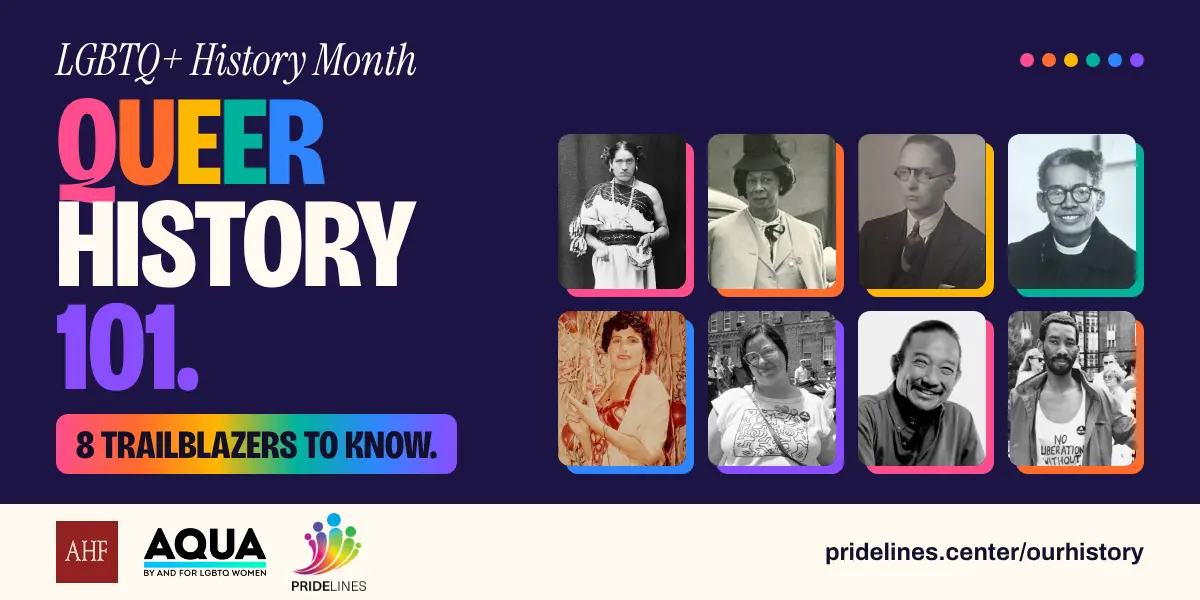
QUEER History 101: Eight Trailblazers and the Story We Share
Every October, LGBTQ+ History Month invites us to remember that we come from somewhere. We come from weavers and physicians, priests and performers, organizers and freedom fighters. We come from people who lived fully as themselves in times and places that offered them very little room to do so.
This year at Pridelines, we’re telling eight of those stories. Some of these names may be new to you. Each of these people changed something lasting, and each of them belongs to all of us.
Why knowing our history matters
A community that knows its history knows it isn’t alone. When a young person in Miami learns that someone like them was honored among the Zuni in the 1800s, or helped lead the struggle against apartheid, something settles in them. They learn that they belong to a long line of people, and that the line runs through every part of the human family.
That is the gift of our particular history. LGBTQ+ people have never been one kind of person. We are born into every race, every nation, every faith, every language, and every generation. Our history is unique because it is woven from the infinite diversity of the human race. We exist in all peoples, all cultures, and all histories.
What intersectionality means
The word for this is intersectionality. Legal scholar Kimberlé Crenshaw introduced the term in 1989 to describe how the different parts of who we are, such as race, gender, sexuality, class, disability, faith, and age, meet in a single life and shape it together. A Black transgender woman moves through the world as all of who she is at once. The barriers she meets and the gifts she carries are formed by every part of her, all at the same time.
Intersectionality asks us to see whole people. It reminds us that our community holds countless stories, and that our movement has always been strongest when it honors everyone in it. The eight people below show us what that looks like. Each of them stood at a crossroads of identities, and each of them made history from exactly where they stood.
We’wha (c. 1849–1896)
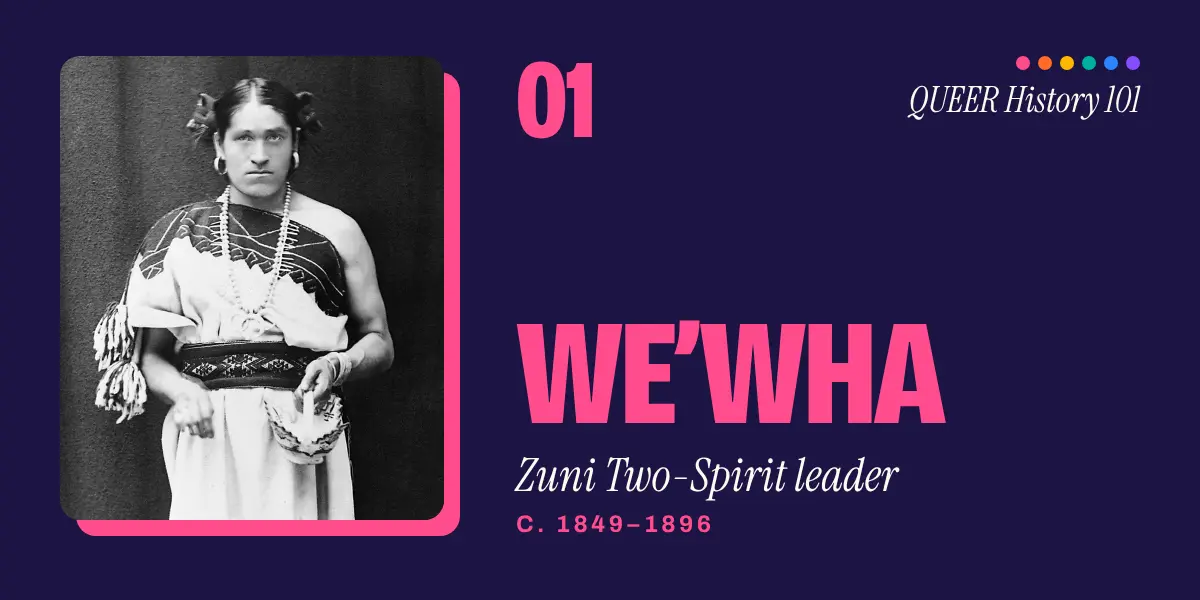
Zuni Two-Spirit leader, artist, and cultural ambassador
We’wha was born around 1849 among the Zuni people in what is now New Mexico. After smallpox took both parents in 1853, We’wha was raised by an aunt and grew into a role the Zuni call lhamana, a person who carries both the work traditionally done by women and the work traditionally done by men. Today many people use the term Two-Spirit for roles like this one. Among the Zuni it was a recognized place in the life of the community, and We’wha took part in both women’s and men’s ceremonial life.
We’wha became an accomplished weaver and potter and was among the first Zuni to make art for sale, opening a path that still supports Zuni families today. In December 1885, We’wha traveled to Washington, D.C., with anthropologist Matilda Coxe Stevenson and stayed about six months. The capital’s social circles welcomed We’wha, and on June 24, 1886, We’wha met President Grover Cleveland.
We’wha’s courage reached well beyond diplomacy. About six years after that trip, We’wha spent a month in prison for standing up to soldiers sent to interfere in Zuni affairs. We’wha died in 1896, shortly after helping to host the Sha’lako festival. This life reminds us that Indigenous nations made room for people like us long before the word LGBTQ+ existed. Our history on this land begins with them.
Lucy Hicks Anderson (1886–1954)
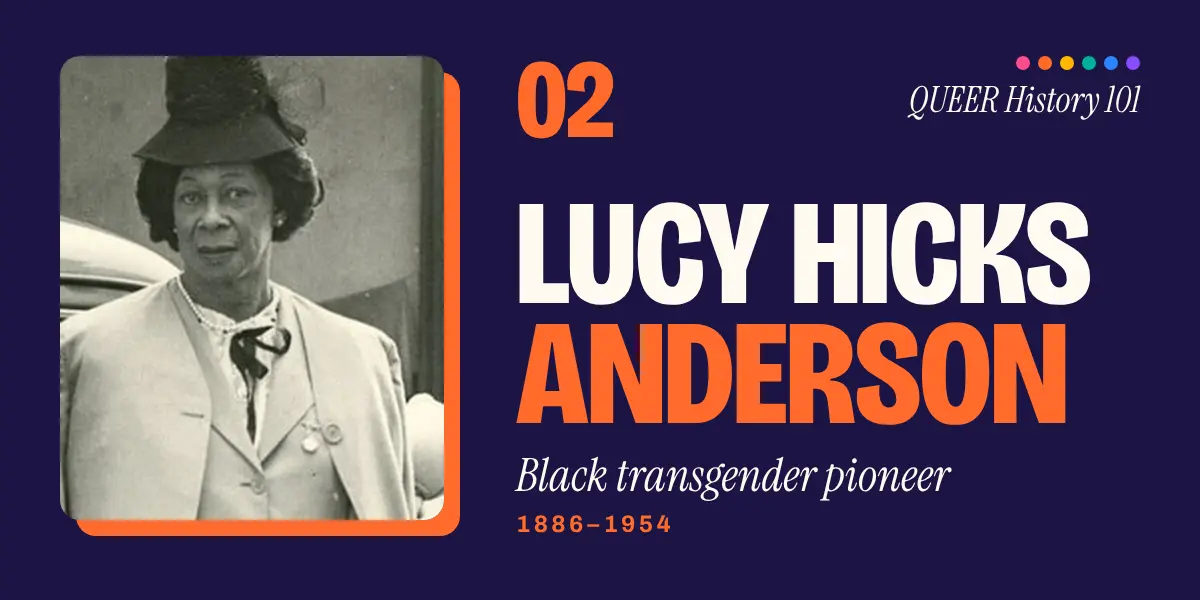
Black transgender pioneer
Lucy Hicks Anderson was born in Waddy, Kentucky, in 1886. From her earliest years she knew she was a girl, and she named herself Lucy. Doctors advised her parents to let her live as the young woman she was, and they did. She wore dresses to school, left at 15 to support herself through domestic work, and eventually made her way west.
Around 1920 she settled in Oxnard, California, where she became known as a gifted chef, a prize-winning baker, and one of the town’s favorite hostesses. She was also a shrewd businesswoman who bought property and ran a boarding house and brothel during Prohibition. In 1944 she married Reuben Anderson, a soldier.
In 1945 the Ventura County district attorney learned that she was transgender and charged her with perjury for signing her marriage license as a woman. Lucy stood in that courtroom and said, “I defy any doctor in the world to prove that I am not a woman.” She was convicted and placed on probation, and the court declared her marriage invalid. Federal prosecutors then charged Lucy and Reuben with fraud over the allotment checks sent to soldiers’ wives, and both went to prison. Barred from returning to Oxnard, the couple lived quietly in Los Angeles until her death in 1954.
Lucy defended her identity and her marriage in open court decades before the word transgender entered common use, and she did it as a Black woman in the 1940s. Her story holds race, gender, and love together in a single life.
Dr. Alan L. Hart (1890–1962)
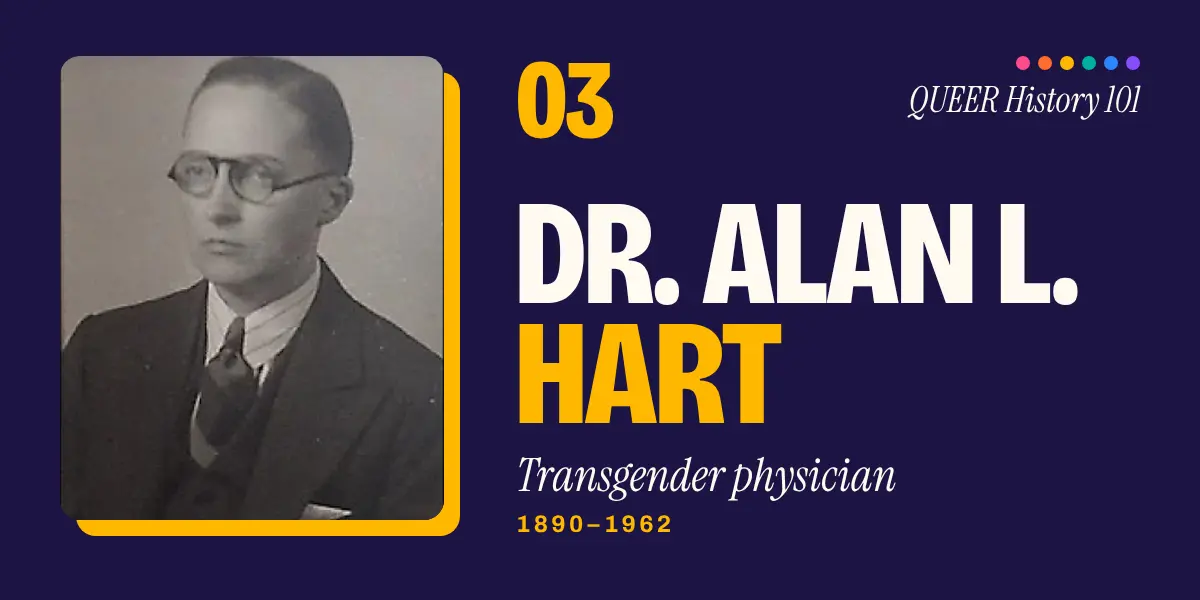
Transgender physician who changed how we fight tuberculosis
Alan L. Hart was born in Kansas in 1890 and grew up in Oregon. He earned his medical degree from the University of Oregon in 1917. That same year he sought medical help to live as the man he knew himself to be, and over the winter of 1917 and 1918 he became one of the first trans men in the United States to have a hysterectomy. He changed his name and began his career as Dr. Alan Hart.
The world made it hard. A former classmate recognized him in 1918, and a newspaper outed him. It happened again in a small Oregon town where he had opened a practice, and he and his wife had to move. He kept going. He earned a master’s degree in radiology from the University of Pennsylvania in 1928 and later a master’s in public health from Yale.
Hart’s great contribution was using X-rays to find tuberculosis early, before the disease could spread. In 1937 he went to work for the Idaho Tuberculosis Association, where he set up the state’s first fixed and mobile screening clinics. In 1948 he took charge of statewide X-ray screening for the Connecticut State Tuberculosis Commission, a post he held for the rest of his life. Researchers credit his methods with saving countless lives. He also published four novels and shared 37 years of marriage with his wife, Edna Ruddick, until his death in 1962.
At Pridelines, where testing and early detection are part of our daily work, his legacy feels close to home. Finding illness early saves lives.
Pauli Murray (1910–1985)
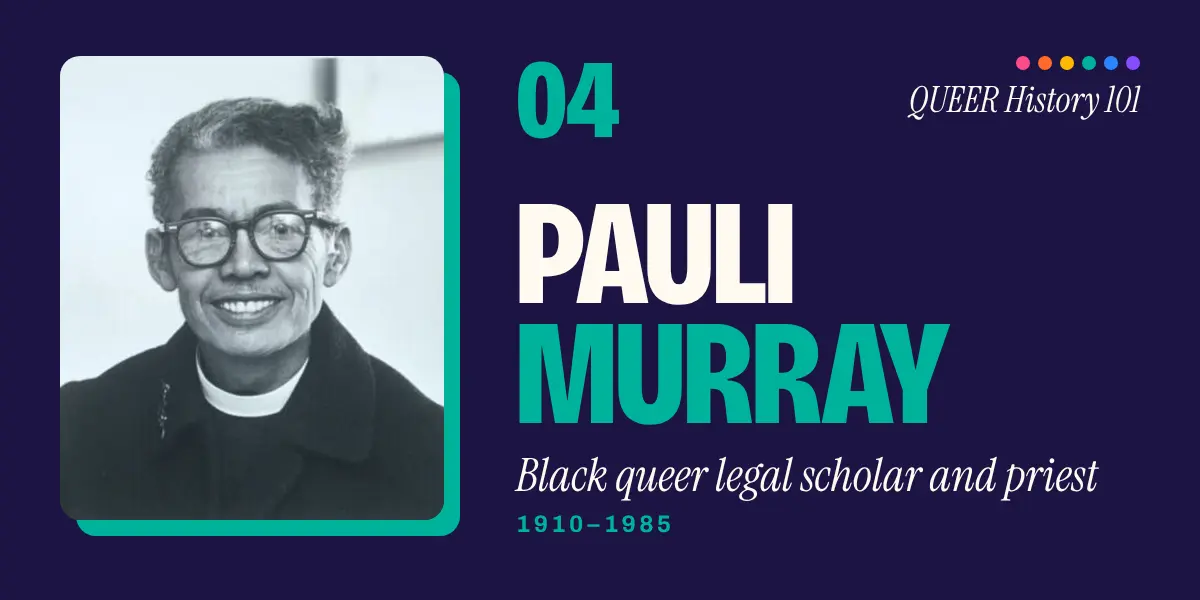
Black queer legal scholar and priest
Pauli Murray was born in Baltimore in 1910 and raised in Durham, North Carolina. Doors closed on Murray early and often. The University of North Carolina rejected Murray in 1938 because of race, and Harvard later refused Murray because of sex. In 1940, fifteen years before the Montgomery bus boycott, Murray was arrested in Virginia for sitting in the white section of a bus.
Murray answered with brilliance. Murray graduated first in the Howard University law class of 1944, the only woman in it, and coined the term “Jane Crow” to name the discrimination Black women faced. Murray’s 1950 book, States’ Laws on Race and Color, became what Thurgood Marshall called the “bible” of the civil rights movement. In 1965 Murray became the first African American to earn a Doctor of Juridical Science from Yale Law School, and in 1966 helped found the National Organization for Women. When Ruth Bader Ginsburg wrote her brief in the 1971 Supreme Court case Reed v. Reed, she named Murray as a coauthor to honor that groundwork.
In 1977 Murray became the first African American woman ordained an Episcopal priest. All through life, Murray’s sense of gender and sexuality reached beyond the categories of the time. Murray loved women, shared nearly two decades with Irene Barlow, and in the 1940s sought hormone treatment. Scholars still discuss which words Murray might choose today, which is why we use Murray’s name here in place of a pronoun. Murray died in 1985, and the Episcopal Church now honors Murray in its calendar of saints.
Murray lived intersectionality decades before the word existed, insisting that race and gender could never be separated in the work of justice.
José Sarria (1922–2013)
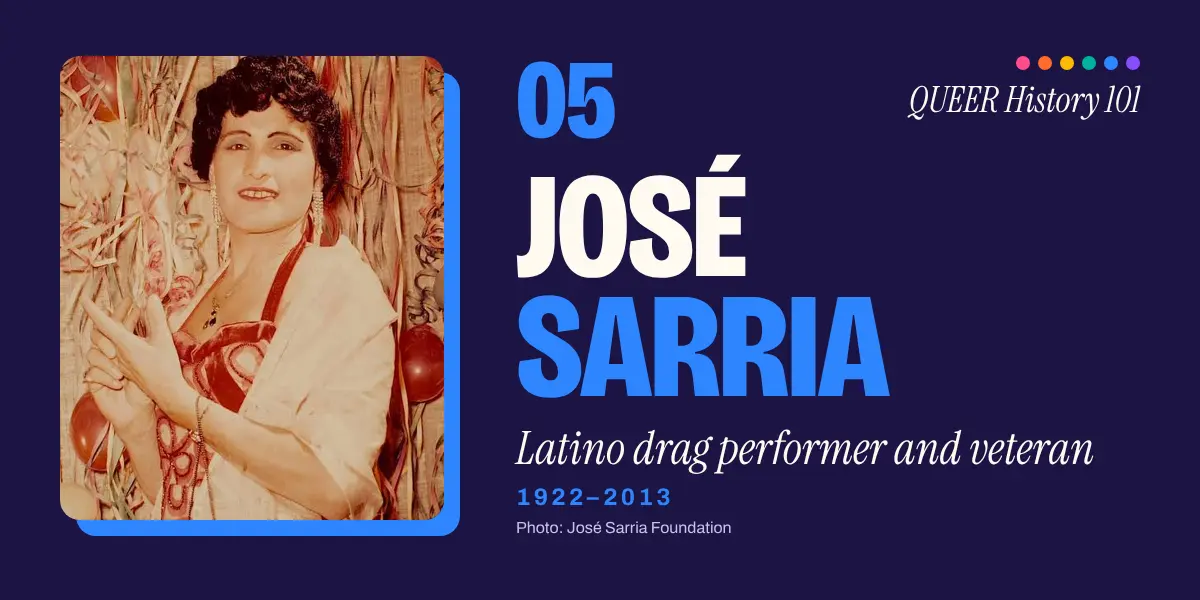
Latino drag performer, veteran, and political trailblazer
José Sarria was born in San Francisco in 1922 to a family of Colombian and Spanish heritage. He served in the Army during World War II and was discharged in 1947 as a staff sergeant. Back home, he took a job as a cocktail waiter at the Black Cat, a bohemian bar, and began singing opera between tables. Soon he was performing several shows a night as “The Nightingale of Montgomery Street,” turning operas like Carmen into comic tales of gay life in San Francisco.
Those shows were joyful, and they were also organizing. At a time when police raided gay bars, José told his audiences, “United we stand, divided they catch us one by one.” At closing time he led the whole bar in song, and sometimes the crowd sang to the men who had been arrested in raids and were held in the jail across the street.
In 1961 he ran for the San Francisco Board of Supervisors, becoming the first openly gay candidate for public office in the United States. He won about 6,000 votes and showed that our community could be a political force. He helped found some of the country’s earliest gay organizations, including the Tavern Guild in 1962, the nation’s first gay business association. In the mid-1960s he proclaimed himself Empress José I, the Widow Norton, and began the Imperial Court System, which today raises money for charity through chapters across the United States, Canada, and Mexico.
José died in 2013, and a street in the Castro now bears his name. He showed us that joy, humor, and glamour can be tools of liberation.
Brenda Howard (1946–2005)
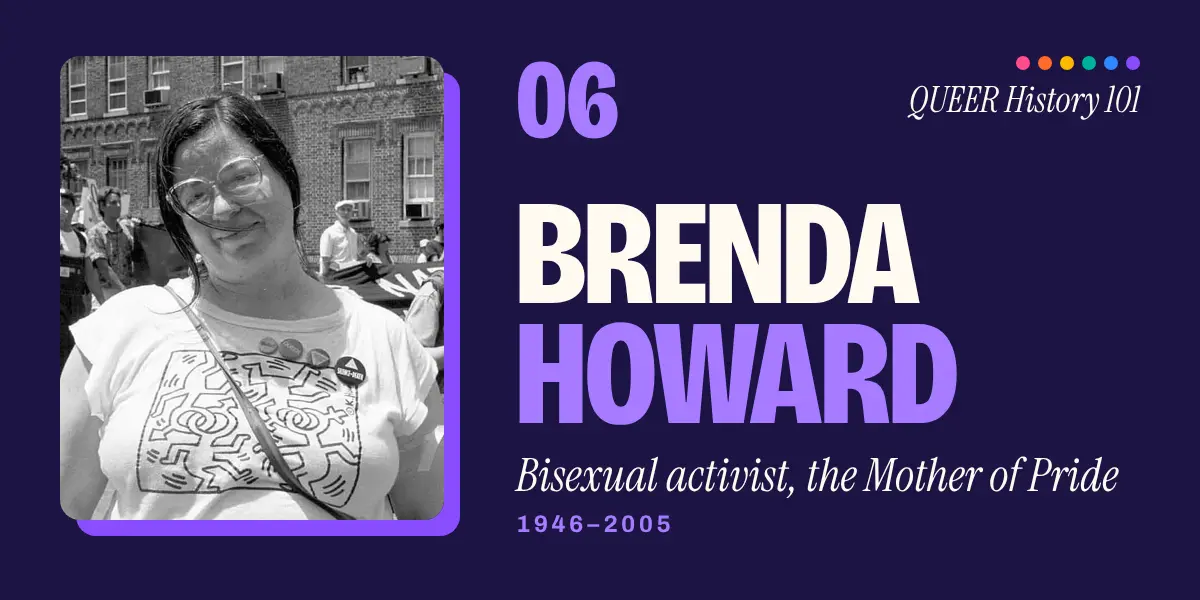
Bisexual activist known as the Mother of Pride
Brenda Howard was born in the Bronx in 1946 and grew up in a Jewish family on Long Island. She trained as a nurse, and in the late 1960s she threw herself into the movement against the Vietnam War. Seeing how men dominated that movement, she became a feminist organizer as well.
After the Stonewall uprising in 1969, Brenda joined the Gay Liberation Front and later chaired the speakers bureau of the Gay Activists Alliance. She helped organize the Christopher Street Liberation Day March of 1970, which marked Stonewall’s first anniversary and became the model for Pride marches around the world. She is also widely credited with the idea of surrounding the march with a full week of events. That is how she came to be remembered as the Mother of Pride.
Brenda spent the rest of her life making sure bisexual people were seen. In 1988 she co-founded the New York Area Bisexual Network, and she successfully lobbied for bisexual people to be named in the 1993 March on Washington. She was active in ACT UP and Queer Nation and was arrested more than once, including at a 1988 demonstration in Chicago for health care and the fair treatment of women, people of color, and people living with HIV. Her partner, Larry Nelson, remembered her as “an in-your-face activist” who “fought for anyone who had their rights trampled on.”
Brenda died on June 28, 2005, the anniversary of Stonewall, during New York City’s Pride Week. Every June, when we gather, we’re walking in something she helped build.
Kiyoshi Kuromiya (1943–2000)
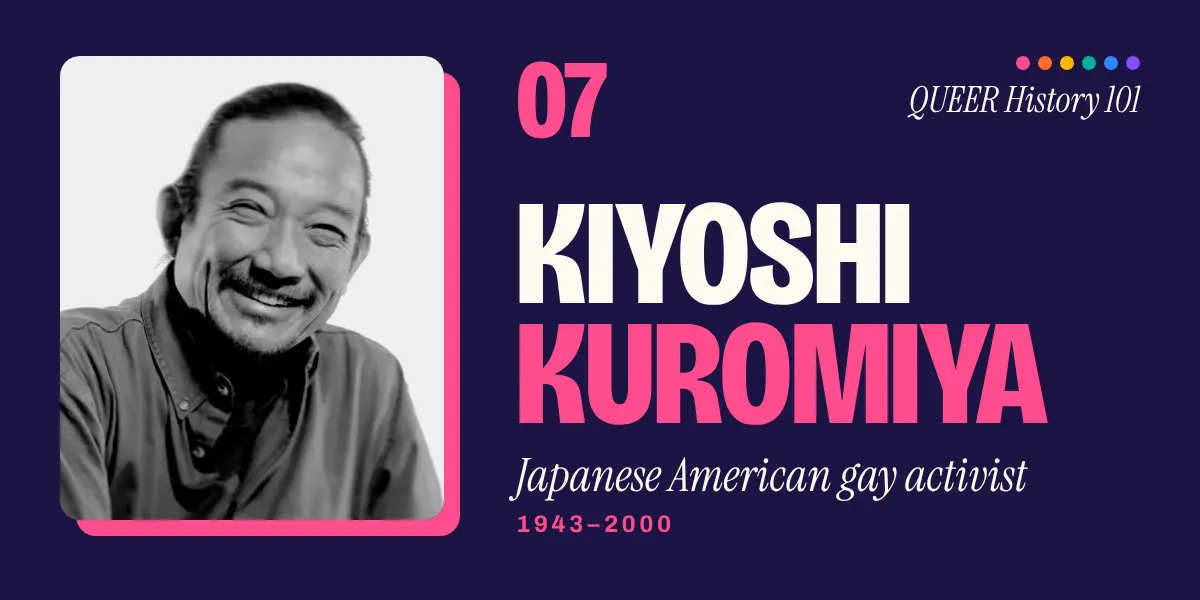
Japanese American civil rights, gay liberation, and AIDS activist
Kiyoshi Kuromiya was born on May 9, 1943, inside the Heart Mountain camp in Wyoming, where the United States government held his family along with thousands of other Japanese Americans during World War II. He grew up in Monrovia, California, and entered the University of Pennsylvania in 1961 to study architecture.
He gave his twenties to the civil rights movement. He joined diner sit-ins in Maryland in 1962 and stood near Dr. Martin Luther King Jr. at the 1963 March on Washington. In March 1965, police in Montgomery, Alabama, assaulted him while he was helping Black high school students register to vote. He grew close to Dr. King, and after the assassination in 1968 he helped care for the King children during the week of the funeral.
On July 4, 1965, he came out publicly at one of the first gay rights demonstrations at Independence Hall in Philadelphia. In 1969 he co-founded the Gay Liberation Front in Philadelphia, and he attended a Black Panther Party convention as an openly gay delegate, building bridges between movements that rarely shared a room.
After his AIDS diagnosis in 1989, he turned his energy to keeping people alive. He helped build ACT UP Philadelphia and founded Critical Path, a newsletter mailed to thousands of people, including hundreds in prison. It grew into one of the first websites offering HIV and AIDS information, with a 24-hour hotline and free internet access for people living with HIV. In 1997 he took part in the Supreme Court challenge that struck down part of the Communications Decency Act, protecting the right to share frank health information online. He died in 2000, one day after his 57th birthday.
Kiyoshi carried every movement he joined into the next one, and each was stronger for it.
Simon Nkoli (1957–1998)
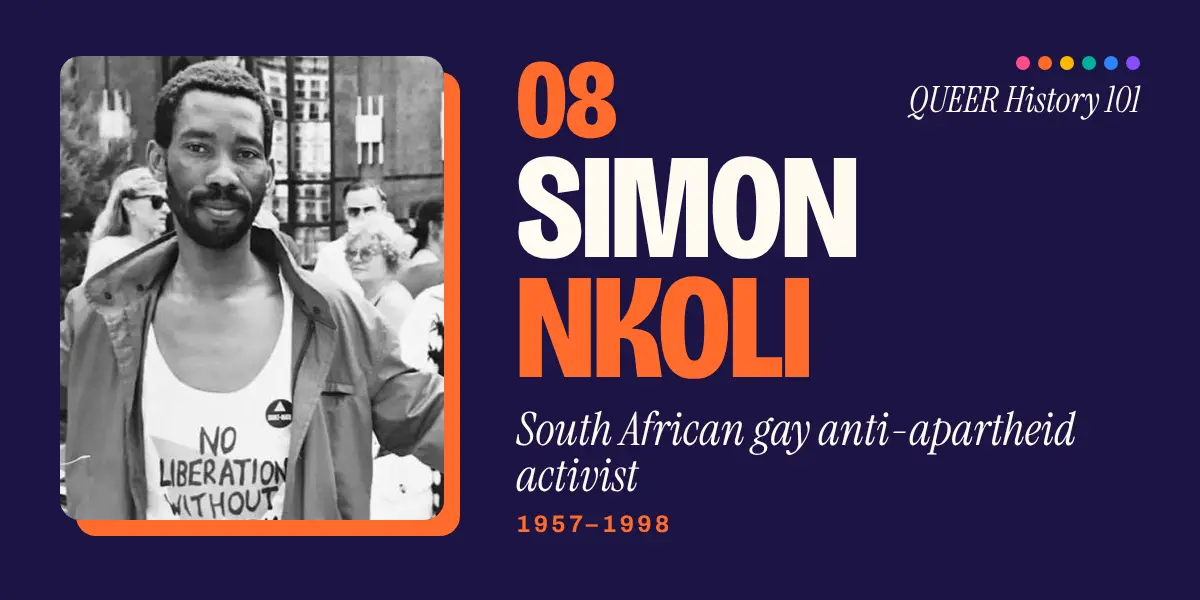
South African anti-apartheid, gay rights, and AIDS activist
Simon Nkoli was born in Soweto in 1957 and came of age in the struggle against apartheid. He was first arrested as a high school student during the 1976 Soweto uprising, and by 1980 he was a regional leader in the Congress of South African Students. In 1983 he joined the Gay Association of South Africa, and the next year he helped form the Saturday Group, a home for gay people of all races.
In September 1984 he was arrested and held for about nine months without charge. He and 21 others were then charged with treason in what became known as the Delmas Treason Trial, and they faced a possible death sentence. In prison, Simon came out to his co-defendants. Some wanted him tried separately. In the end they stood trial together, and his honesty changed how leaders of the liberation movement understood gay people. He was acquitted in 1988.
That same year he co-founded the Gay and Lesbian Organization of the Witwatersrand, known as GLOW. In October 1990, GLOW organized South Africa’s first Pride march, and about 800 people walked through Johannesburg. Simon told the crowd, “I am black and I am gay. I cannot separate the two parts into secondary and primary struggles.”
He helped mobilize the coalition that kept protection for sexual orientation in South Africa’s 1996 constitution, the first in the world to include it, and he met with President Nelson Mandela in 1995 as part of that work. Simon was also one of the first Black South Africans to speak openly about living with HIV, and he founded support groups for others. He died of an AIDS-related illness in 1998 at age 41.
Simon’s words at that march may be the clearest definition of intersectionality we have.
We exist in all peoples, cultures, and histories
A Zuni artist. A Black chef in California. A country doctor. A priest and legal scholar. A drag performer and veteran. A bisexual organizer from the Bronx. A man born behind barbed wire. A freedom fighter from Soweto. These eight lives look very different on the surface, and they share everything that matters. Each of them brought their whole self to the work of freedom.
This is what our history teaches. LGBTQ+ people are found in every people, every culture, and every chapter of the human story. When we learn these names, we learn that our community is as wide as humanity itself, and that every one of us has ancestors to call on.
At Pridelines, we carry this history into our work every day, because people who know where they come from can imagine where they’re going.